
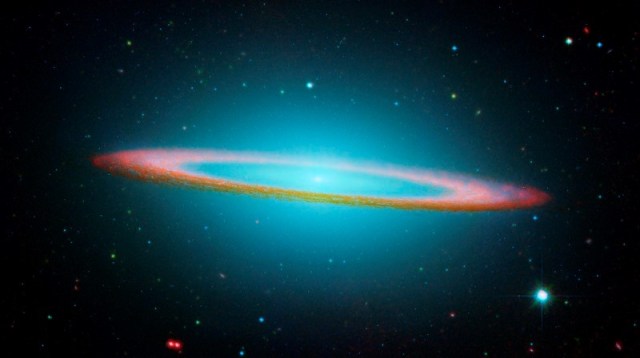
The Hubble space telescope was launched in 1990, and over its lifetime it has had four astronaut visits to do updates and maintenance. With the end of the shuttle program, we no longer can do maintenance or repairs, but Hubble is expected to continue to function for ten years or so. Scientist say that we have learned more from Hubble than any other scientific instrument in history. With it we have studied black holes, observed quasars, discovered the presence of dark matter, seen planets associated with stars in other galaxies, observed an asteroid disintegrating, and seen parts of the universe at 3% of its present age, to name a few accomplishments. To us as lay people the most dramatic things are the glorius images it has captured. I’ve appended a picture of the beautiful sombrero galaxy of which Hubble managed to get an edge view. It’s hard to believe that this picture displays hundreds of billions of stars, most of which are brighter than our Sun.
The reason that Hubble has been so successful is that it is out in space where it can get a clear view. Any picture of space taken from earth suffers severe distortion from the atmosphere; also, the ambient light obscures the much weaker light that comes from distant stars. The idea of a space telescope was first raised in 1945, well before anyone had the capability to put anything in space. Paul in 1 Corinthians 13:12 makes a similar point about our spiritual life. Our earthly presence distorts and dims our visions of the spiritual realm. Here is 1 Corinthians 13:12 as it appears in The Message. “We don’t yet see things clearly. We’re squinting in a fog, peering through a mist. But it won’t be long before the weather clears and the sun shines bright! We’ll see it all then, see it all as clearly as God sees us, knowing him directly just as he knows us!” The best part of the verse is its promise; we WILL see it all clearly. It’s another example of how God loves me and YOU unconditionally.
Jim
 Joy Lutheran Church Ocala, Florida