
The Flanders area of Belgium saw some of the fiercest fighting of WWI, and the British Commonwealth troops suffered great casualties there. You may remember the poem “In Flanders Fields by the Canadian Army doctor John McCrae. It starts off
In Flanders Fields the poppies grow
Between the crosses, row on row.
He was moved to write the poem by seeing the poppies grow on the new graves of dead comrades. If you drive around Flanders today, you will find that it is a rural area, and you will also see that many fields contain well-groomed military graveyards. Some contain less than a hundred graves, while others are very large. I am told that poppies still bloom between the crosses each spring.
The Germans had attacked France through Belgium using a plan devised by von Schlieffen. It was a large sweep around the end of the French flank (the soldiers on the right-most flank were supposed to able “to dip their sleeves in the sea.”) Belgium was neutral at the time and the German command thought that the Belgians would not greatly react. The Belgians, however, did not see the invasion as a kindly act. Most of the troops opposing the Germans were from the Commonwealth, since neutral Belgium didn’t have a large army. The losses were terrible.
Ypres (pronounced Ee’-prah) is a town of about 30,000 people and is the major one in the area. There is a very good WWI museum there, and its displays pull no punches in telling about the horrible action in the area, which was led by clueless generals in a largely senseless war. After the war the British wanted to build a memorial to the young men who had died in the area, and, in conjunction with the town, they built a formal gate to the town, called the Menin Gate. It is a large imposing structure that creates a tunnel over the main road.
In 1928 the people of Ypres wanted to do something to thank the Commonwealth soldiers who had fought on their behalf against the Germans. They decided to do something that would keep that gratitude alive far into the future. They committed to having the bugle corps of the local fire brigade play `Last Post’ at the Menin Gate each evening at dusk. This is the British equivalent of our `Taps’ and is played for a fallen soldier. After a few minutes of silent meditation, during which visitors often place wreaths, they play `Rouse.’ This is similar to `Reveille’ and symbolizes resurrection. This been done continuously, regardless of the weather, ever since, except for the four years during WWII, when the Germans once again occupied the town. For those years the ceremony was moved to England. Paulette and I were fortunate enough to have experienced this very moving ceremony.
We have just entered the season of Lent, and I think that for me, recalling this ceremony is good preparation for the Easter weekend. Our hymns this season help us remember the crucifixion, much like the playing of `Last Post’ recalls fallen soldiers. On Easter we have a song that is even better than `Rouse;’ we sing `Christ the Lord is risen today, Alleluia!’ What a wonderful way to remember God’s unconditional love for YOU and me.
Jim
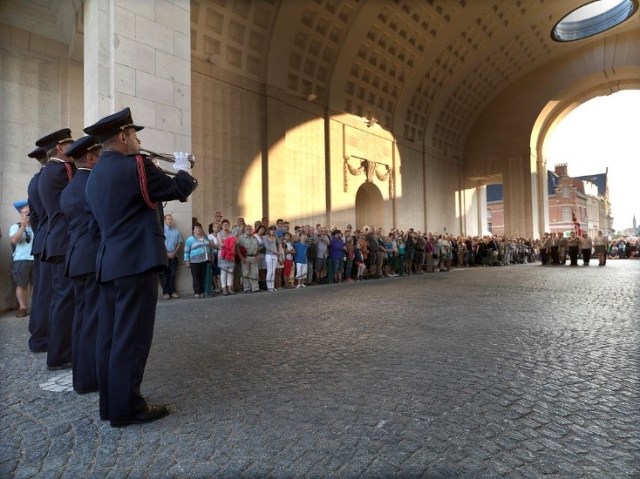
Last Post Ceremony at Menin Gate
 Joy Lutheran Church Ocala, Florida