
We are coming up to Election Day, and this election season we have been inundated with political ads on television. There have been so many that I’m looking forward to seeing lawyer ads again. I thought there has to be a better way, and I remembered the way the remaining eleven disciples chose Matthias to replace Judas. They cast lots! Well, choosing the President by casting lots would get rid of the ads, but maybe leaving it to chance might not be the best way to choose a President. Indeed, there was more than chance involved in the choice of Matthias as told in Acts 1:23-26. First, they carefully nominated two men: Barsabbas and Matthias. Second, they prayed to the Lord. Finally, they cast the lots. This is the only mention of the practice in the New Testament, but it occurred a number of times in the Old Testament.
Before retiring to Ocala, Paulette and I were members of a Moravian church in Winston-Salem, North Carolina. During the 1700s the Moravians used casting lots in making many of their decisions with the practice gradually ending early in the 1800s. The founding of the city is one example of its use. Originally Winston and Salem were separate towns; Salem, founded in 1766, was a carefully planned Moravian religious community, and Winston was a secular town that grew up adjacent to it (they joined in 1913). Before laying out the streets of Salem the Moravians developed several feasible plans, prayed for the Lord’s guidance, and then cast lots to decide among the plans. Usually the method was used to select religious leaders, but at times it was also used to choose Marriage partners. Marriage was very much a religious matter, and a young man would propose a potential partner to the Church. Lots were cast (by drawing slips of paper from a box), and an answer of yes, no, or (essentially) wait was given. The young woman was free to accept or reject the proposal. Here is a picture of a Moravian lot box.
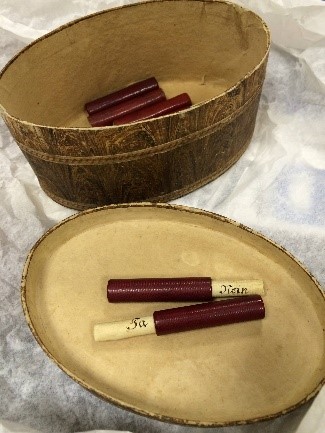
I’m not proposing that we should use casting lots for making secular or church decisions, but there were certain practical advantages: it helped to make decisions impartial and unbiased, and it lessened the chances of hurt feelings in choosing leaders. These should be goals for us also. In choosing church leaders, as Christians we should certainly follow the disciples in nominating good people, praying about the decision, and being open to heavenly guidance. Like the early Moravians we should plan carefully and consider all feasible options, praying for direction both during the process and at decision time.
Please read Acts 1:23-26 and remember: God loves YOU unconditionally.
Jim
 Joy Lutheran Church Ocala, Florida