
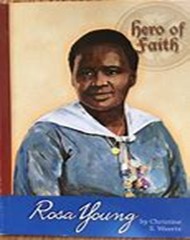
Most of us are familiar with Rosa Park and her courageous bus ride. There was another Rosa who preceded her by many years. Rosa Young, born to former slaves Grant and Nancy Young, entered this world in 1890. She is named as the mother of Black Lutheranism in Alabama.
Unlike Jehu Jones, Rosa Young’s story has a significant amount of written history, including an autobiography titled Light in the Dark Belt published in 1920. She is an inspiring and courageous woman.
From early childhood, Rosa was recognized as a bright child who would benefit from a formal education. This was highly unusual for a black child in the Jim Crow Era. Her early education was provided by an uncle who had attended Tuskegee Institute. When she was able to attend the local public school, she entered at the 5th grade and completed the 6th grade-the highest grade offered. She worked in the cotton fields during vacation times and saved enough money to enter Payne University in Selma, Alabama.
She graduated with honors and delivered the Valedictory on the topic of Service to Mankind. “It is our duty to relieve human wants. Let us place our standard high, but be willing to do the lowest task, the most distasteful labor, be ever helpful and generous, and be ready to lend a helping hand.” (From her Valedictorian Speech found in Light in the Dark Belt, Rosa Young, St. Louis, MO: Concordia Publishing House, 1929. Pg. 50). She became an itinerant teacher, traveling from school to school in the area surrounding Rosebud, Alabama.
Her passion for education moved her to establish a school with consistent stability for the children. She organized fundraising and brought the Rosebud Literary and Industrial School into being. The school was successful by all accounts until the arrival of the Mexican Boll Weevil which decimated the cotton crops throughout the South, resulting in massive job loss and no discretionary money for tuition.
It was at this time that Rosa appealed to Booker T. Washington for a funding suggestion. Washington replied that he and Tuskegee were not in a position to assist but told Rosa about the work of the Lutheran church in the South. Rosa wrote to the Missouri Synod and received a positive response and support in the form of money and a missionary, the Reverend Nils Bakke.
Together, they worked to bring Lutheran schools and churches to the Black communities of Alabama. This was done at great personal sacrifice on Rosa’s part. Former friends and supporters from other religions labeled her with derogatory names and spread rumors about what the Lutheran church was going to do to black people. All outrageous and false, but scary to people who had minimal education and worldly experience.
Rosa was the first to be confirmed into the Lutheran Church when Christ Lutheran Church was opened in Rosebud. In 2015, The Lutheran Church Missouri Synod (LCMS) made a documentary about Rosa. It is a well-done presentation of Rosa’s life and her relationship with God. It is about 40 minutes long but will inspire you with the miraculous things that can be done with the help of God. (https://vimeo.com/thelcms/thefirstrosa)
Rosa notes that her actions were guided by her complete trust and love of God. She prayed and wrote. She prayed and acted. She prayed and she listened for the answer. She knew that God loved her unconditionally. That God loved all those little children that she wanted to teach and bring to God. She continued to teach and work with God until she went to her eternal reward in 1971.
Always remember that God loves you unconditionally.
Terri
 Joy Lutheran Church Ocala, Florida